Quarterly Scientific Journal of Audio-Visual Media

Quarterly Scientific Journal of Audio-Visual Media

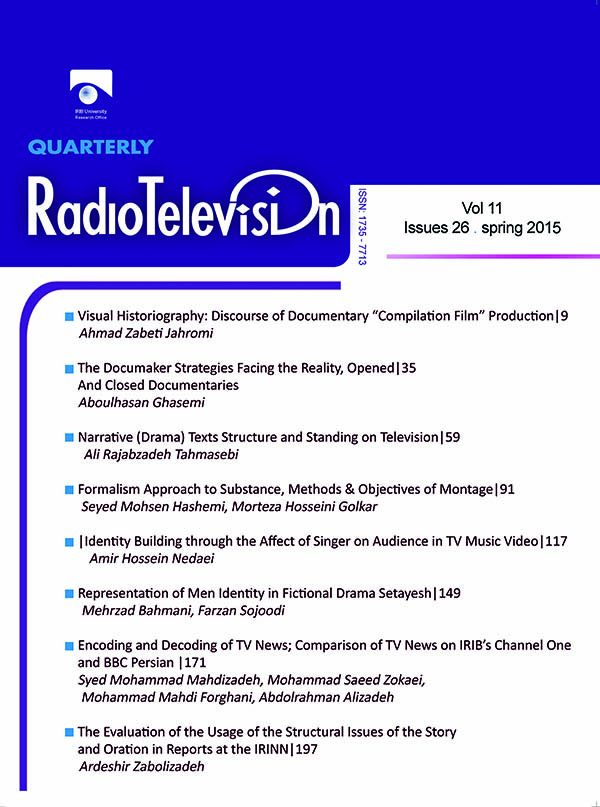
Identity building through the affect of singer on audience in TV music video

Document Type : Research Paper

Author
Abstract
The music video is a relatively new and influential form in TV programming which is the most used form of music in TV. Music video as an attractive form is widely used in many West TV channels. This is a new tool to expand the expressive possibilities in film –making forms and media arts. But the important point is its undeniable impact on audience’s minds. Its audiences are often the youths.
The main question of this research is, to what extent the typology of music video and the star (singer) have an impact on audience's mind to build an identity? Therefore this article tries to find a typological framework for the perception of identity in the music video as a popular phenomenon. The discussion in this article is the West music video in which the singer plays a Key role. Image of a piece of music is highly dependent on the singer as the narrator, story characters, creator of the piece and ideally the thoughts induction of the West media policy-makers. Indeed, the music video applies new indications to communicate with the audience and affect the audience’s unconscious. According to media researchers, this encoding is a convenient theme for identity and ideology induction in youth’s minds. These ideologies are sometimes appeared as a decadent thinking (as opposed to the cultural norms of society) and sometimes as an expenditure culture (for more dependent youth).
 Therefore,this article gives a brief revision of music video history, then introduces a typology of its effective elements, studies on the mechanism and function of star making in music videos and finally analyzes this ideal system to attract an audience and build a new identity for him/her.
Studying on effective functions of this phenomenon fits among the most important today academic discussions in media sciences, visual arts, and social psychology.

- Ayerroff, Jeff, (2000), “Thirty Frames per Second; The Visionary Art of the Music Video”, Adams, New York
- Butler, Jeremy G. , (1991), “Star texts: Image and Performance”, Wayne State University Press, Dertroit, PP. 49-66.
- Cavell, Stanley, (1979),”The World Viewed”, Harvard University Press, Cambridge
- Cook, David, (1995),”A History of Narrative Film”, W. W, Norton & Company, New York
- Dyer, Richard, (1979), “Stars”, British Film Institute (BFI) Publishing, London.
- Goodwin, Andrew, (1993), “Dancing in the Destruction Factory”, Routledge, London.
- Gunning, Tom, (1991), D. W. Griffith and Origin of Narrative Cinema, University Press of Illinois, Urbana.
- Hall, Stuart, (1991), “Postmodernism or the Cultural Logic of Late Capitalism”, Duke University Press, Durham.
- Kaplan, Ann, (1989), “Rocking Around the Clock”, Routledge, London.
- Kinder, Marsha, (1984), “Music Video and Spectator: Television, Ideology and Dream”, Film Quarterly, Vol. 38, No. 1, University of California Press, PP. 2-15.
- Middleton, Richard, (2002), “Studying Popular Music”, Open University Press, Bukingham.
- Mulvey, Laura, (1988), “Feminism and Film Theory”, Routledge, New York.
- Shore, Michael, (1984), “The Rolling Stone Book of Video”, Sedgwick & Jachson Ltd. , London.
-Williams, Raymond, (1990), “Television Technology and Cultural Form”, Routledge, London.
- Vernallis, Carol, (2004) “Experiencing Music Video: Aesthetics and Cultural Context”, New York, Columbia University Press.