اسماعیلیان، ملیحه؛ و ناظمی، امیر (1397). «ارائۀ الگویی برای نهاد تنظیمگر رسانههای نوین صوتی- تصویری»، فصلنامه مطالعات راهبردی سیاستگذاری عمومی، دوره 8، شماره 25.
بند 2 ابلاغیه مقام معظم رهبری مورخ 22/6/94 خطاب به جمهور بهعنوان رئیس شورای عالی فضای مجازی.
دهقان، نرگس (1394). تحقیق تفسیری- تاریخی، دانشگاه آزاد اسلامی، واحد نجفآباد اصفهان، https://research.iaun.ac.ir/pd/dehghan/pdfs/UploadFile_7411.pdf
شورای نگهبان قانون اساسی (1379). نظریه تفسیری شورای نگهبان اصول یکصد و هفتاد و پنجم و چهل و چهارم قانون اساسی، مادة (18) آئیننامه داخلی (شورای نگهبان) در جلسة مورخ 6/7/1379.
صادقی فسایی، سهیلا؛ و عرفانمنش، ایمان (1394). «مبانی روششناختی پژوهش اسنادی در علوم اجتماعی، مورد مطالعه: تأثیرات مدرنشدن بر خانواده ایرانی»، فصلنامه علمی پژوهشی راهبرد فرهنگ، 8(29), 61-91.
عالیزاده، عبدالرضا (1385). اجرای روش تحقیق به روش دلفی، تهران، انتشارات یوسف.
عزتی، مرتضی (1376). روش تحقیق در علوم اجتماعی، تهران، انتشارات دانشگاه تربیت مدرس.
فرخزاد، پرویز (1384). راهنمای پژوهش تاریخی (کتابخانهای)، طهور.
قاسمی، حمید؛ و فنازاد، رضا (1397). حقوق رسانه، تهران، انتشارات اندیشه آرا.
قانون اساسی جمهوری اسلامی ایران (1368). مرکز پژوهش های مجلس شورای اسلامی.
کاراندیش، علی اصغر (1399).
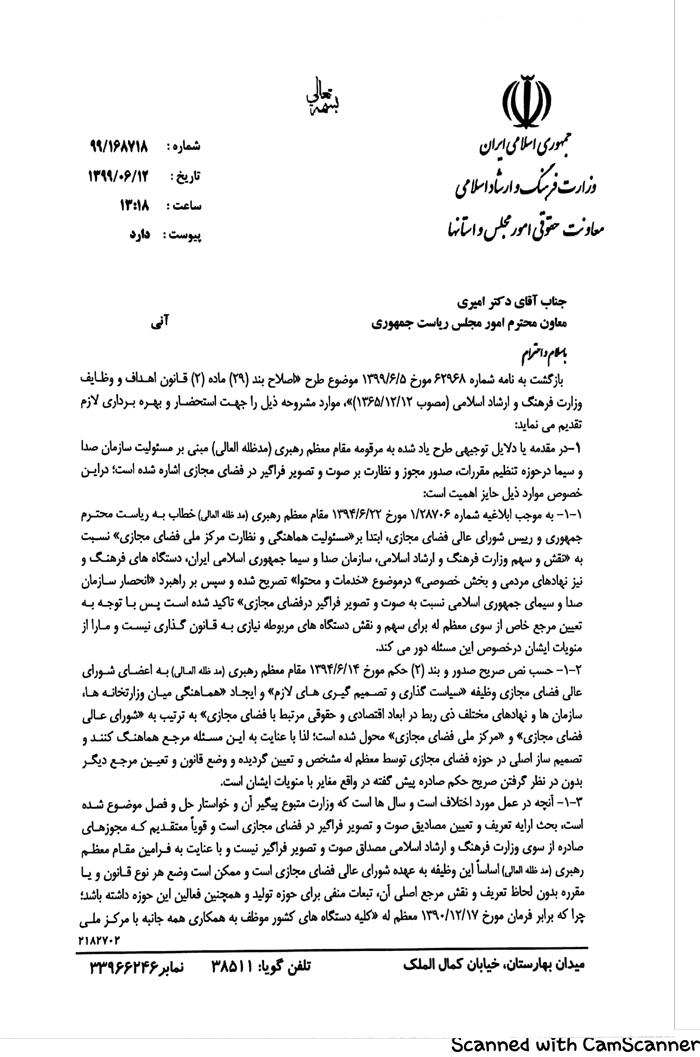
نامه موضوع طرح اصلاح بند (29) ماده (2) قانون اهداف و وظایف وزارت فرهنگ و ارشاد اسلامی، مصوب «12/12/1365»
https://cdn.tabnak.ir/files/fa/news/1399/6/12/1235981_481.jpg
کارگروه تعیین مصادیق محتوای مجرمانه (1392). مصوبه شصت و دومین جلسه کارگروه تعیین مصادیق محتوای مجرمانه.
مصوبه شورای عالی انقلاب فرهنگی (1375). ضوابط و مقررات تأسیس مراکز، مؤسسات، کانونها و انجمنهای فرهنگی و نظارت بر فعالیت آنها.
Betzel, M. (2011). Finetuning Classification Criteria for On-demand Audiovisual Media Services: The Dutch Approach. In S. Nicoltchev (Ed.). Iris Special: The Regulation of On-demand Audiovisual Services: Chaos or Coherence? (pp. 53–62). Strasbourg: European Audiovisual Observatory.
Beutler ,Roland. (2017). Evolution of Broadcast Content Distribution. Springer International Publishing Switzerland 2017.
Burri-Nenova, M. (2007). New Audiovisual Media Services Directive: Television without Frontiers, Television without Cultural Diversity, The. Common Market L. Rev., 44, 1689.
Cappello Maja. (2019). Striking the right c(h)ord? New EU rules on audiovisual content online. European Audiovisual Observatory. Moscow, 29 October 2019.
Cisco (2017), Cisco Visual Networking Index Predicts Global Annual IP Traffic to Exceed Three Zettabytes by 2021 https://newsroom.cisco.com/press-release content? type=webcontent&articleId=1853168
Commission Council. (1984). Green Paper on the Establishment of the Common Market for Broadcasting, especially by Satellite and Cable. COM (84) 300 final - Brussels, 14th June 1984.
Commission Council. (2005). Proposal for a Directive of the European Parliament and of the Council amending Council Directive 89/552/EEC on the coordination of certain provisions laid down by law, regulation or administrative action in Member States concerning the pursuit of television broadcasting activities {SEC (2005) 1625} {SEC (2005) 1626}.
Council Directive 89/552/EEC of 3 October 1989 on the coordination of certain provisions laid down by Law, Regulation or Administrative Action in Member States concerning the pursuit of television broadcasting activities.
D’Arma, A. (2010). Italian television in the multichannel age. Change and continuity in industry structure, programming and consumption. Convergence, 16 (2), 201-215
Directive 2002/21/EC of the European Parliament and of the Council of 7 March2002 on a common regulatory framework for electronic communications networks and services, OJ of 24.4.2002, L 108, p
European Council, Presidency Conclusions, Lisbon, 23 and 24 March 2000, at para 5
Gianni, Origoni, Grippo, Cappelli & Partners. (2011). The new resolutions of the Italian media authority on the audiovisual media services via the Internet. Retrieved from www.gop.it/doc_pubblicazioni/59_a8uoa94lak_eng.pdf
Gillham, B. (2000), The Research Interview, London, Rautledge.
Grainne, de Burca and Scott, Joanne. (2001) The EU and the WTO: Legal and Constitutional Issues. Oxford: Hart Publishing, 2001.
Hermanns & Matzneller. (2011), “Whose boots are moade for walking?” Regulation of Ondemand Audiovisual Services, European Audiovisual Observatory, Strasbourg 2011, 7-30.
Kalamar, D. (2015). Convergence of media and transformation of audience. Informatol, 49(3–4), pp. 190–202
Holliman, Richard (2010). Media convergence. In: Priest, Susanna ed. Encyclopaedia of Science and Technology Communication. Newbury Park, CA, USA: Sage.
Janssen, M. (2012).
New Services and Scope: What’s in, What’s out Revisited – The Belgian CSA Recommendation, 35th EPRA meeting, Portorož, 31 May, 2012.
http://www.epra.org/attachments/portoroz-plenary-1-new-services-and-scopepresentation-by-marc-janssen
Jenkins, H. (2009, September 24). In a social networking.
Koskei Isabell et al. (2014). The Internet Economy - Regulatory Challenges and Practices, ECO/WKP (2014)67
Laskowski, K. (2019). Changes to the Audiovisual Media Services Directive – what does it mean for the media market? https://www.mondaq.com/broadcasting-film-tv-radio/795192/changes-to-the-audiovisual-media-services-directive-what-does-it-mean-for-the-media-market
Latzer, Michael, Natascha Just, Florian Saurwein, and Peter Slominski. (2002) Selbst- und KoRegulierung im Mediamatiksektor. Alternative Regulierungsformen zwischen Staatund Martk. Wiesbaden: Westdeutscher Verlag, 2002. http://www.mediachange.ch/media/pdf/publications/Latzer-etal_2002_Selbst--Ko-Regulierung.pdf.
Laurence, G, Kaplan, C.(199R). he European Community's Television without Frontiers Directive: Stimulating Europe to Regulate Culture. 8 Emory Int'l L. Rev. 255 (1994)
Lotza, D. (2007). The television will be revolutionized. New York & London: New York University Press
Machet, E. (2011).
Content Regulation and new Media: Exploring Regulatory Boundaries between Traditional and new Media. Background document to 33rd EPRA meeting, Ohrid.
http://epra3production.s3.amazonaws.com/attachments/files/102/original/Ohrid_session1_revised.final.pdf?1327492407
Machet, E. (2012).
New Media & Regulation: Towards a Paradigm Shift? New Services andScope: “What’s in, what’s out Revisited.” Comparative background document to 35
th EPRA meeting, Portorož.
http://epra3-
Mikos, L. (2016). Digital Media Platforms and the Use of TV Content: Binge Watchingand Video-On-Demand in Germany.
Media and Communication, 4(3), 154.
https://doi.org/10.17645/mac.v4i3.542
Official Journal of the European Union. (2007). DIRECTIVE 2007/65/EC OF THE EUROPEAN PARLIAMENT AND OF THE COUNCIL of 11 December 2007 ELI:
http://data.europa.eu/eli/dir/2007/65/oj
Official Journal of the European Union. (2018). DIRECTIVE (EU) 2018/1808 OF THE EUROPEAN PARLIAMENT AND OF THE COUNCIL. ELI:
http://data.europa.eu/eli/dir/2018/1808/oj
Postel, J. ed. (1981). Internet Protocol, DARPA Internet Program.
Raf Schoefs. (2013) “Connected TV: Editorial Responsibility in a Converged Media Environment,” https://www.scriptiebank.be/sites/default/files/webform/scriptie/SCHOEFS%20RAF%20-%20Connected%20television_0.pdf
Smith, R. (2007). Media Convergence and the Regulation of Audiovisual Content: Is the European Community's Audiovisual Media Services Directive Fit for Purpose? Current Legal Problems; Oxford Vol. 60, Iss. 1,
Valcke Peggy and Ausloos Jef. (2013).
“What if Television Becomes Just an App?” Re-Conceptualising the Legal Notion of Audiovisual Media Service in the Light of Media Convergence. See discussions, stats, and author profiles for this publication at:
https://www.researchgate.net/publication/259620739
Valcke, P., & Ausloos, J. (2014). Audiovisual Media Services 3.0:(Re) Defining the scope of European broadcasting law in a converging and connected media environment. In The Palgrave Handbook of European (Media Policy), Palgrave Macmillan, (pp. 312-328, London.
Valcke, P., Stevens, D., Werkers, E., & Lievens, E. (2009). Audiovisual media services in the EU: next generation approach or old wine in new barrels? Communications & Strategies, (71), 103.
Verweij, J. (2011). YouTube and the Audiovisual Media Services Directive. Media Forum, 2011(4), 105-113.
Viola, R. & Cappello, M. (2011). Regulating on-demand services in Italy. In Nicoltchev, S. (Ed.). Iris Special: The Regulation of On-demand Audiovisual Services: Chaos or Coherence? (pp. 47–52). Strasbourg: European Audiovisual Observatory.
Weinand Jenny. (2018). Implementing the EU Audiovisual Media Services Directive. Selected issues in the regulation of AVMS by national media authorities of France, Germany and the UK. Nomos Verlagsgesellschaft, Baden-Baden, Germany 2018. Printed and bound in Germany.
Wolfgang Schulz and Stefan Heilmann. (2008). Editorial Responsibility. European Audiovisual Observatory, Strasbourg.
Woods Lorna. (2018). Revision of Audiovisual Media Services Directive – Video-sharing Platforms.